

Insights / Home Services
How Much Should an HVAC Company Spend on Marketing in 2026? (With the $153 CPL Benchmark)
HVAC marketing budget math for 2026: 8–12% of revenue, the $153 cost-per-lead benchmark, and how to split spend between LSA, Google Ads and your site.
By Nick Irmo · November 17, 2026 · 6 min read

An HVAC company should budget 8–12% of revenue for marketing in 2026, including ad spend. A $1.5M shop lands at $10,000–$15,000 a month; a $3M shop at $20,000–$30,000. The industry-average cost per lead is about $153, so the real question is not the percentage, it is how many booked jobs that budget has to produce to pay for itself.
This article walks through the math. If you want to see how we run this for HVAC contractors in the Chicago northwest suburbs, the HVAC marketing page has the full program.
What do the benchmarks say an HVAC company spends?
Two widely cited sets of numbers, both from marketing vendors, so treat them as directional:
- WebFX's 2026 HVAC benchmarks put average marketing spend at 7% of annual revenue, average cost per lead at $153, efficient campaigns at $25–$75 per lead, and customer lifetime value at $15,340 (WebFX). The same report has Google Ads CPC for HVAC climbing from $26.22 in 2022 to a projected $32.77 in 2025.
- Foundry CRO's trade benchmarks put HVAC at 8–12% of revenue, with an average ticket of about $1,850 and an allowable customer acquisition cost of roughly $1,534, calculated as 10% of lifetime value (Foundry CRO).
The gap between 7% and 12% is the difference between a company holding steady and one trying to add a truck. Pick the end of the range that matches your goal, not the one that feels comfortable.
What does the budget look like at your revenue?
| 8% (steady) | 12% (growth) | Monthly at 10% | |
|---|---|---|---|
| $750,000 | $60,000 | $90,000 | $6,250 |
| $1,500,000 | $120,000 | $180,000 | $12,500 |
| $3,000,000 | $240,000 | $360,000 | $25,000 |
| $5,000,000 | $400,000 | $600,000 | $41,700 |
That number covers everything: Google Ads and Local Services Ads spend, the website, software (call tracking, review tools, CRM), print or direct mail, and whoever manages it, whether that is an in-house hire or an agency. A common mistake is treating the agency fee as the marketing budget and the ad spend as a separate surprise.
How do you turn the budget into a booked-job target?
Percent-of-revenue tells you how much to spend. It does not tell you whether the spend is working. For that you need three numbers from your own books:
- Average ticket. Benchmarks say ~$1,850 for HVAC, but your mix of repairs, maintenance and replacements sets yours. A replacement-heavy shop may be above $4,000.
- Booking rate. The share of leads (calls plus forms) that become a scheduled job. Many shops are between 40% and 60% once wrong numbers and spam are removed.
- Lifetime value. Average ticket times jobs per year times years retained, plus maintenance-plan revenue. Maintenance-plan attachment is what makes HVAC lifetime value high. Foundry CRO cites 65–75% attachment for HVAC companies that push plans.
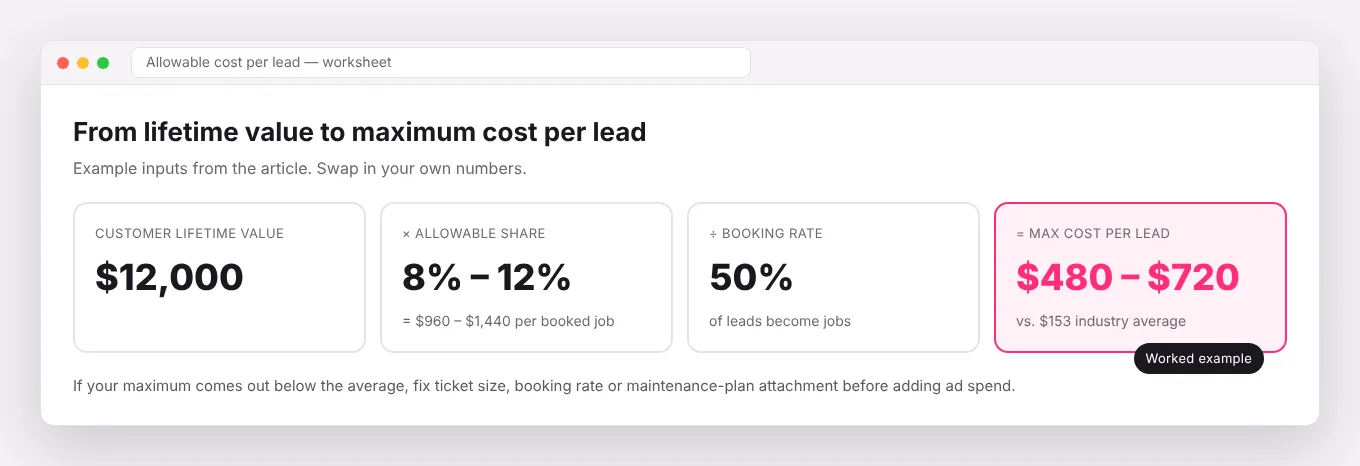
Then: allowable cost per booked job = 8–12% of lifetime value. If your lifetime value is $12,000, you can afford to pay $960–$1,440 to acquire a customer and still have a healthy business. Divide that by your booking rate and you have your maximum cost per lead. At a 50% booking rate, that is $480–$720 per lead, well above the $153 average. The benchmark is a floor to beat, not a ceiling to fear.
If your allowable cost per lead comes out below $153, the problem is not marketing. It is ticket size, booking rate or plan attachment, and more ad spend will not fix it.
Where should the money go?
For a $1.5M–$3M HVAC company, a reasonable split of the monthly budget:
| Share | Why | |
|---|---|---|
| Local Services Ads | 25–35% | Pay per lead, Google Guaranteed badge, top of the page. Adoption among contractors has grown to roughly 70% (PipelineOn, citing agency account data), so not being there is a visible gap. |
| Google Search Ads | 25–35% | Captures "furnace repair near me" (48,000 US searches a month per WebFX) and emergency intent LSA misses. Seasonal: heavy in late spring and early fall. |
| Website and local SEO | 10–15% | Service pages and town pages. "Dedicated page for each service" is the #1 local-organic ranking factor in Whitespark's 2026 survey (Whitespark). |
| Reviews and GBP | 5–10% | Mostly software and labor. 74% of consumers want to see reviews from the last three months (BrightLocal LCRS 2026). |
| Retention (email/SMS to past customers, maintenance plans) | 5–10% | Cheapest revenue you will ever book. |
| Management (agency or in-house) | 15–25% | The people running the above. |
Notice what is not on the list at any meaningful share: general brand awareness, billboards, sponsored social posts with no offer. Those can work at $10M. At $2M they are a tax.
When should you spend above the range?
Three situations justify going past 12% for a season or a year:
- You just added capacity. A new truck and tech need to be fed. Spend ahead of revenue for 60–90 days.
- You are entering a new town. Service-area pages, a GBP strategy and ads need a running start.
- It is March or September. Air-conditioning searches rise sharply from February into July and heating searches from August through December (Foundry CRO cites Google Trends for the AC figure). Front-load spend into the ramp, not the peak, when CPCs are highest.
And one situation where you should spend less: if your response time to new leads is more than 15 minutes. Fix that first. Spending more to generate leads nobody answers for two days is the fastest way to confirm "marketing doesn't work."
What does this look like in practice for a NW-suburb HVAC company?
Take a $2.4M shop in Palatine with six trucks. At 10%, the budget is $20,000 a month. A sensible first-year allocation:
- $7,000 LSA and Google Ads spend
- $3,000 agency management (we run this through the Home Services Growth Stack at $3,000 a month, month-to-month, plus a $1,500 setup fee)
- $1,500 website improvements and service-area pages, amortized
- $800 call tracking, review automation and CRM
- $1,200 past-customer email, SMS and maintenance-plan campaigns
- $6,500 held for the spring and fall seasonal pushes
Then measure cost per booked job by channel every month and move money toward whatever is cheapest.
Frequently asked questions
What percentage of revenue should an HVAC company spend on marketing?
Industry benchmarks range from 7% to 12% of annual revenue, including ad spend, software and management. Use the low end if your schedule is full and you are protecting share; use the high end if you are adding trucks or entering new towns. A $2M company at 10% budgets about $16,700 a month.
What is a good cost per lead for HVAC?
The industry average is about $153 per lead according to WebFX's 2026 benchmarks, with well-run campaigns at $25–$75. Your own ceiling should come from your numbers: take 8–12% of customer lifetime value as your allowable acquisition cost, then divide by your booking rate. For most HVAC companies that produces a maximum cost per lead well above $153.
Should an HVAC company use Local Services Ads or Google Ads?
Both, if the budget is above roughly $5,000 a month. Local Services Ads charge per lead and sit at the top of the page with the Google Guaranteed badge. Search Ads capture urgent "near me" searches and let you control messaging by service. Start with LSA, add Search Ads once tracking is in place, and compare cost per booked job between them monthly.
How much does an HVAC marketing agency cost?
Local agencies typically charge $4,000–$6,000 a month before ad spend for companies in the $1M–$3M range; national home-services firms often charge $8,000–$15,000 with 12–24 month contracts. Clicking Awesome's Home Services Growth Stack is $3,000 a month, month-to-month, plus a $1,500 setup fee and ad spend paid directly to Google.
Want your own number, not the benchmark? Our Numbers Call is $1,500, credited against your first retainer month. Thirty minutes on your ticket, booking rate and capacity, then a written allowable-CAC model, channel plan and 12-month budget within five business days. Start with the two-minute quiz.
Nick Irmo is the founder of Clicking Awesome, a marketing agency in Barrington, IL. More at irmomarketing.com.