


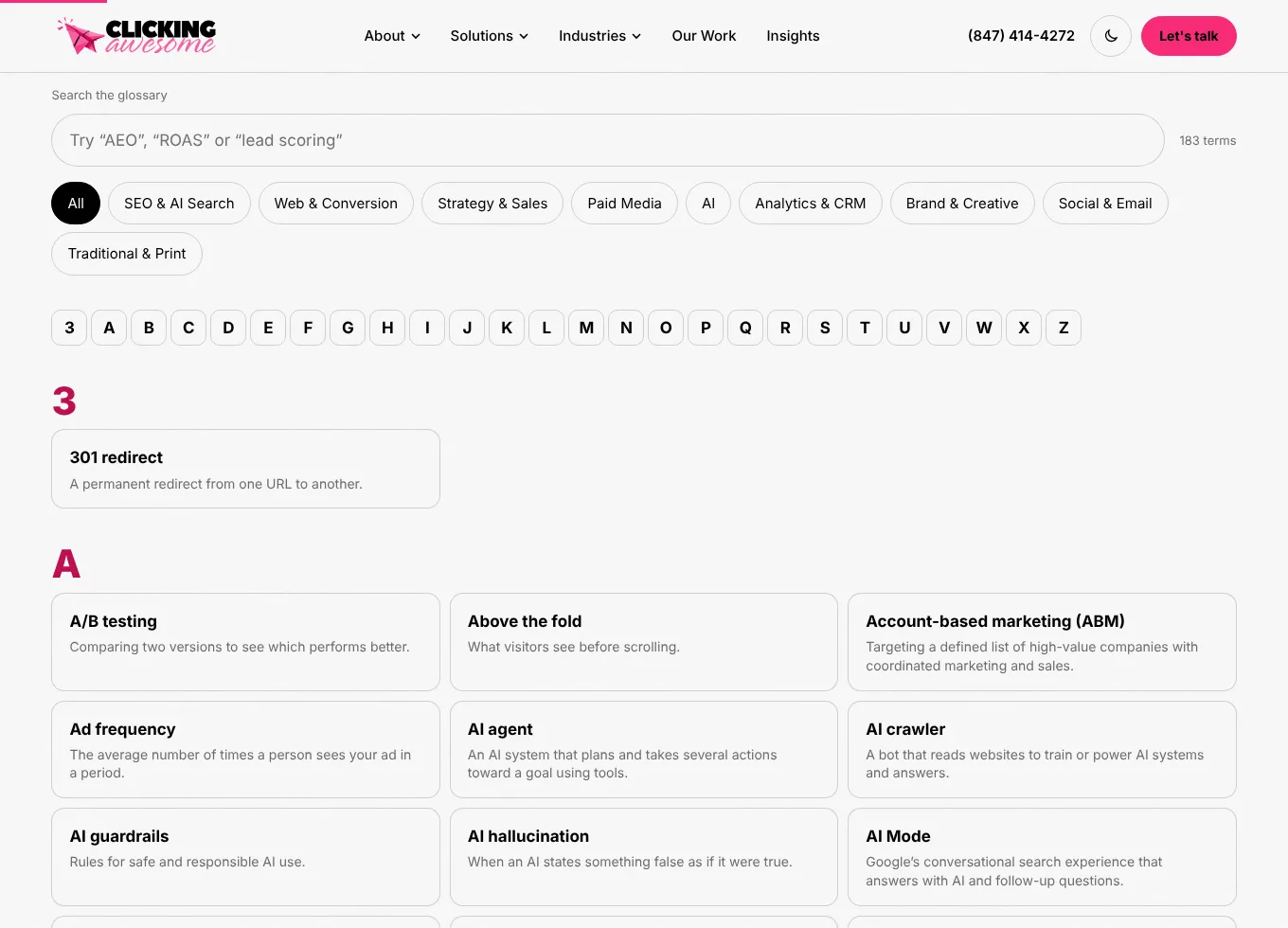
A glossary is a set of short, accurate definitions of the terms your customers use, each on its own page or anchored section, linked from everywhere the term appears. It works unusually well in AI search because answer engines are constantly asked "what is" questions, and a clean, authoritative definition is the easiest passage to quote.
Why it works
- Definitional questions are among the most common prompts in AI assistants and search.
- A glossary entry answers in the first sentence, which is exactly what engines lift.
- Each entry is a natural internal link target, strengthening every article and service page that uses the term.
- It signals topical authority: you know the vocabulary of your field well enough to define all of it.
In our founder’s in-house work at a Chicago law and tax firm, a 235-term tax glossary became the foundation of the content program and a 235-video YouTube series built on top of it.
How to build one
- List every term your sales team explains on calls and every term that appears in your services.
- Write a one-sentence definition first, then two or three sentences of context and an example.
- Give each term its own URL and DefinedTerm structured data.
- Link related terms to each other and to the service or article where the term matters.
- Make it searchable, and link terms automatically the first time they appear in articles.
| Part of the term page | What goes in it | Why |
|---|---|---|
| Definition | One sentence, starting with the term | The passage engines lift |
| Explanation | Two or three short paragraphs in plain language | Satisfies people who need more |
| Example | A concrete case from your industry | Shows experience, not just knowledge |
| Related terms | Three to six links | Builds the topical web |
| Related service | One link to the service it connects to | Turns definitions into leads |
| Schema | DefinedTerm inside a DefinedTermSet | Labels the page for machines |
Common mistakes
- Copying definitions from elsewhere. It adds nothing and earns nothing.
- Writing for search engines instead of customers. Plain words win both.
- Building it once and never updating it.
Frequently asked questions
How many terms should a glossary have?
Start with 50 to 100 core terms and grow it as customers ask new questions.
Should each term have its own page?
Yes for important terms. Separate URLs can rank and be cited individually.
Our own marketing glossary is linked across this site. We build the same thing for clients, in their vocabulary.