


Topical authority is the trust search engines and AI assistants place in a site that covers a subject thoroughly and well. You build it with content clusters: a pillar page that answers the main question broadly, surrounded by focused articles that answer every important sub-question, all linked to each other. It beats publishing random posts because each page makes the others stronger.
Map the cluster
- Pick a topic you can genuinely be an authority on, tied to a service you sell.
- List the questions buyers ask at each stage: learning, comparing, deciding.
- Group them: one pillar for the broad topic, cluster articles for specific questions, and a glossary entry for every key term.
- Check what already ranks and is cited, and plan to be more useful, specific and first-hand.
| Page type | Job | How many | Example |
|---|---|---|---|
| Pillar or service page | Answer the big question and convert | 1 per cluster | CRM consulting |
| Supporting article | Answer one narrower question in depth | 8 to 20 | HubSpot vs Salesforce for a 20-person company |
| Comparison or cost page | Help a buyer decide | 2 to 4 | What a fractional CMO costs |
| Glossary term | Define one term in one sentence, then explain | 10 to 40 | Lead scoring |
| Industry page | Show the topic in a buyer's world | 1 per industry | CRM for mortgage teams |
Publish in the right order
- Pillar page first, even if short, so cluster posts have a home to link to.
- Bottom-of-funnel cluster posts next: costs, comparisons, "how to choose."
- Then middle and top-of-funnel posts that feed readers toward the pillar and the service.
Link it together
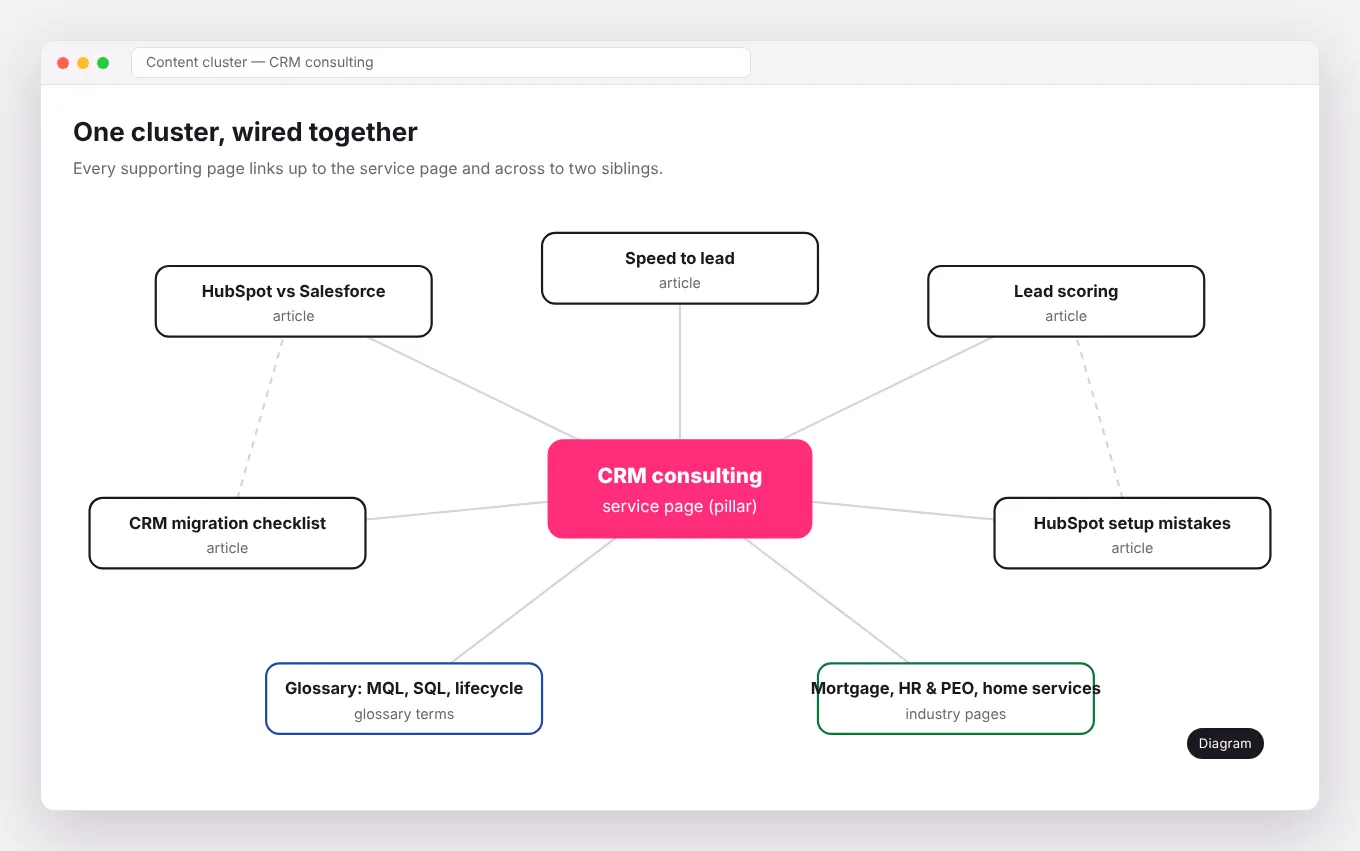
Every cluster post links to the pillar with a descriptive anchor, the pillar links to every cluster post, and related posts link to each other. Link glossary terms the first time they appear. Internal links are how both crawlers and readers understand the shape of your expertise.
Keep it fresh
Review the cluster twice a year. Update facts and prices, merge overlapping posts and add answers to new questions you hear from customers.
Frequently asked questions
How many articles does a cluster need?
Enough to answer the questions that matter, often 8 to 20. Quality and coverage beat a fixed number.
Can a small business build topical authority?
Yes, by going narrow: one service, one industry or one region, covered better than anyone else.
We plan clusters around the services that make you money, then write, publish and measure them.